
30 Defensible Product Strategies
AI is changing software. This is how you can build a product that has defensible moats.

Random Observation/Comment #927: AI will make you work smarter, not harder.
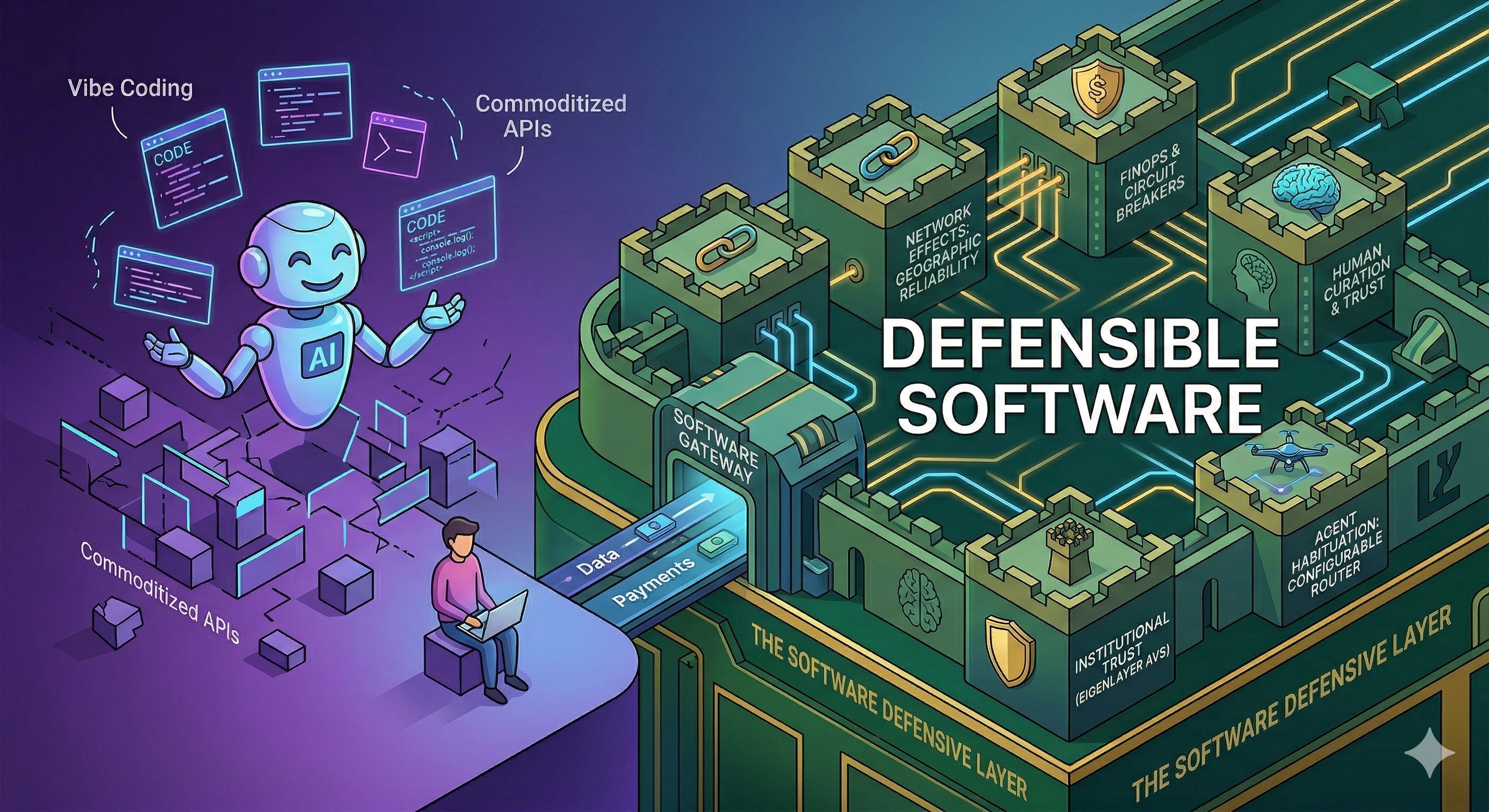
//Nano banana doing a good job
Why this list?
If there are no moats and switching costs for software goes to 0 then what is the special sauce of a company? Why would I not just vibe code my own features and use your API? Or better yet, start to de-platform myself and just start owning my own data?
I’m thinking about how this as how we can create moats in our own projects. This may not apply to software anymore, but maybe we can see different ways it does. Features can be copied. Platform stickiness helps with habits. Users can change patterns slowly. AI agents are probably the most fickle.
The Foundations of Defensibility
Network Effects - The classic. The product becomes exponentially more valuable as more people use it (e.g., a marketplace or a social protocol).
Proprietary Data Loops - Not just having data, but a system where every user interaction improves the model/product for the next user, creating a gap competitors can’t bridge.
High Switching Costs - The “pain of migration.” This isn’t just about technical lock-in, but the mental energy required to move a workflow.
Brand as Trust - In a world of infinite AI-generated “vibes,” a brand that stands for “this won’t break” or “this is ethically sourced” becomes a massive moat.
Platform Habituation - When a tool becomes “muscle memory.” You don’t use it because it’s the best; you use it because your fingers know the shortcuts. What apps do you open up by default when you need that dopamine hit on your phone?
Integration Depth - Being the “glue” between ten other indispensable tools. If removing you breaks the ecosystem, then you’re safe.
Community Sovereignty - A group of users who feels a sense of ownership. You can copy a feature, but you can’t “vibe code” a community of 10,000 advocates.
The “Human” Moats
Curation and Taste - AI can generate everything, but it can’t tell you what’s cool or right for your specific context. Taste is the new frontier of defensibility.
Distribution Power - Having the “pipes” to get a product in front of people. Even a mediocre app with 1 million eyeballs beats a perfect app with zero.
The “Lindy Effect” of Reputation - The longer your software has existed and stayed reliable, the more likely it is to be chosen by risk-averse enterprises.
Localized Nuance - Software that understands specific cultural, legal, or regional “un-written rules” that a general LLM might miss.
Personal Identity - Software that becomes part of who the user is (e.g., your blog, your fitness tracker, your specific setup). I personally think this is a great place to start as you own your AI Operating System and tech stack.
Technical & Structural Barriers
Regulatory Moats - Compliance, SOC2, HIPAA. This is the boring stuff that “vibe coders” hate doing but enterprises require.
Hardware Synergies - Software that works better because it’s optimized for specific hardware (the Apple approach).
Economies of Scale - Being able to provide the service so cheaply because of your infrastructure that it’s not worth it for someone to “vibe code” their own.
First-Party Hardware/IoT - If your software controls a physical device in my house, I’m not switching easily. Especially if this is a one-time purchase, then I’m probably going to feel like there’s a sunken coast to already have a particular brand or type of hardware.
Unique Algorithms - While rare now, there are still “math-heavy” problems that a prompt can’t solve as well as a dedicated PhD team.
Defensive Strategies in the AI Age
The “Workflow” Moat - Don’t just provide an API; provide the entire end-to-end experience that saves a human 4 hours of clicking. More importantly, this could save your agent hours of clicking and interpreting GUIs.
Vertical Integration - Solving everything for one specific industry (e.g., software just for dental hygienists) rather than being a horizontal tool.
Offline Capabilities - In a world of cloud-dependency, being the tool that works in a cabin in the woods is a moat.
Predictive Anticipation - Not just responding to prompts, but knowing what the user needs before they ask based on historical context.
Permissioned Access - Holding the keys to a specific, high-value network or gated set of information.
Intellectual & Personal Moats
The “Founder’s Vision” - A roadmap that makes sense five years out. AI can iterate on the now, but it struggles to invent a specific future. I think the Founding team itself needs to agree on where the whole product heads towards for this collaborative joint arrow towards new opportunities.
Patent Portfolios - The old-school way. Still effective for protecting core underlying IP in certain jurisdictions.
Exceptional Support - When things break (and they will), having a human who answers the phone is a moat. I feel like these might be longer sessions and maybe fun if they were in person.
Education and Certification - If you train the workforce to use your tool, the workforce will demand your tool at their next job.
Speed of Evolution - If you ship faster and build a corpus of features then your vibe code output starting from scratch from different people every time will not catch up fully. I’m looking forward to better tooling.
Exclusivity - Intentionally limiting access to create a “velvet rope” effect.
Emotional Resonance - Making the user feel something. Most software is cold, so building the stuff we love is defensible.
Simplicity - In a world of “infinite features,” the tool that does one thing perfectly and then gets out of the way is the most defensible of all.
~See Lemons Work on Defensible Software